Personalization as Digital Moat
When I recently tried to switch from one music streaming service to another, it was technically done in ten minutes. In practice, though, I’m still with the old one, not because the new one isn’t good, but because the old one simply knows me better.
It knows my listening habits inside and out. It knows what I listen to in the morning on the way to work to get motivated and what I listen to in the evening to wind down. Even though music doesn’t really serve that mood function for me, my old streaming service was very diligent at recognizing what mood I was typically in at what time of day. And it built playlists that kept surprising me with how accurately they recognized my taste. It keeps suggesting new music I didn’t know but that I like. That took a long time of course. It had taken years of data and feedback. And the poor new service has to start from zero.
That’s what I called the moat. And the strategy behind it is no secret, because personalization has always created barriers to competition. The better you know your customer, the harder it is for them to leave. That’s the unfriendly version of customer retention.
The difference between a good product and a moat is the direction of the pull. A good product attracts because it’s good. A moat holds because leaving is annoying.
I quickly learned that I can’t arrive at the new service where I was at the old one. I couldn’t take my profile and my trained algorithm with me, and that data is the property of the service. What I thought was “my” profile was actually “its” profile about me.
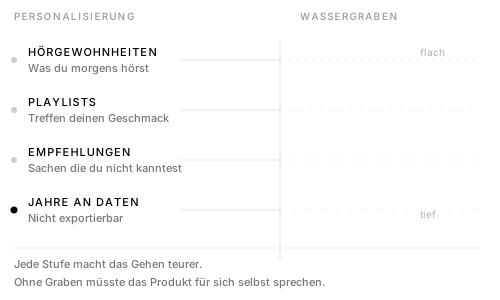
In software development, personalization goes through various stages. Each stage collects data, tries to understand the customer better and deliver more accurate results. In the process, each stage makes the moat a bit deeper. But that’s obviously not a side effect, it’s a central point.
It’s become common knowledge that a company investing a hundred million in personalization doesn’t do it out of kindness. But to make the moat even deeper and thus more expensive for the competition. In economics these are called switching costs. The costs that arise when you switch. They’re not always measured in money, but also in nerves and patience.
This isn’t just the case with music, but everywhere. Especially with software. You work with a program for ten years and have learned all the templates and workflows until every shortcut is second nature. At some point there’s an alternative program that would probably be a better fit. But you stay with the old one anyway. Because you can’t take the work of the last years you invested with you.
From the company’s perspective, that’s a competitive advantage. From the customer’s perspective, it’s the loss of freedom of choice through the back door. Nothing is directly taken from you and you apparently have freedom of choice. But every day you stay makes switching more expensive and the moat slowly fills up.
That’s the really clever part. An obvious prison creates resistance. An invisible one doesn’t. Personalization is the nicest prison ever built. It adapts to you and learns your preferences. Everything becomes more pleasant at first, but with every day also harder to get out of. If personalization is such a great feature, why can’t you take the profile with you? Why can’t I export my data and my preferences along with my trained algorithm? The answer is simple. Because then the moat would be empty. And without the moat, the product would have to speak for itself.
Let’s ask ourselves the question: how much of what we call customer retention stayed because the product is good? And how much stayed because leaving got too expensive?
How these texts are written is explained here.