What's left when everything is automated?
The list of what AI can take over keeps growing. Scheduling. Answering emails. Writing reports. Summarizing meetings. Managing customer support. Generating leads. Managing projects from start to finish. Onboarding clients.
The list is endless. I examined part of it in my book and that was still at the very beginning of AI applications. I read this list and then read it again. And then I tried to imagine a job description that doesn’t appear on it.
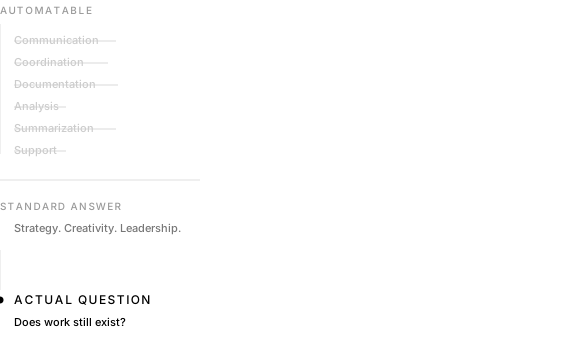
The list isn’t complete but I think it’s representative. Because it doesn’t primarily map individual tasks but categories: communication, coordination, documentation, analysis, summarization, support and so on.
I’ve spent over thirty years in organizations. As a consultant, as an owner, co-owner, team member, across all kinds of industries. And if I’m honest, a large part of my work consisted of exactly these tasks. Preparing meetings, summarizing results, writing emails, producing reports, coordinating people. Most of that was the core of my work, because summarizing a meeting isn’t administration when the meeting was the decision, and an email isn’t routine when it resolves a conflict.
The conversation doesn’t distinguish between the what and the how. It sees: answering emails. And it says: AI can do that. But an email to an anxious client where you say the right thing in three sentences because you understand what they’re really asking is a different thing from an email with a scheduling proposal. It’s the same activity. It’s not the same task.
Automation sees categories. Humans see situations. The category “customer support” contains a thousand different moments, nine hundred of which are genuinely automatable and a hundred of which aren’t. But those hundred are the ones the customer remembers, the ones where they felt that someone was really listening. I’ve experienced moments myself where a complaint turned into a deep client relationship.
So what’s left when the list is done? My standard answer used to be: strategic and creative work. And leading people. That’s what always comes up when people try to explain why humans are still needed. But strategy doesn’t emerge in a vacuum. It emerges in the meetings that get summarized. Or in the emails that get answered. If you take that away, there’s no strategy left. There’s a person sitting in an office who no longer knows what to think about, because all the information that feeds their thinking is running through machines.
I’m not saying nothing should be automated. Of course automation makes sense, but some of it is just boring because it repeats constantly. Unfortunately, it’s precisely in these repetitive tasks where mistakes happen. A machine does that better. But what’s left? That’s not a side question. It’s an important question that isn’t taken seriously enough.
The honest answer to the question of what’s left when everything is automated would be: we don’t know. Nobody has ever followed this list to the end, because at the end of the list stands something nobody wants to say out loud. At the end of the list stands the question of whether work still exists.
Not whether employment still exists. Whether there’s still work that a human must do because a machine can’t. The answer to that question determines more than efficiency. It determines the role of humans in an economy that may no longer need them.
How these texts are written is explained here.