Why Architects Always Start from Zero
It went on forever with this window seal and my architect drew and drew, coordinated with the carpenter who naturally saw everything completely differently and countered with more drawings. Granted, it was the weather side in a region with plenty of rain and the occasional wind, but it was not only my trust in the two of them that sank dramatically with every additional line, but also the question of whether we were breaking new ground here and attempting to solve this problem of global significance as the absolute pioneers of weather-exposed facades for the very first time. The best part though: water came in, on the very first rain with moderate wind, nowhere near storm force. The solid wood floor suffered visibly. Architect and carpenter inspected the damage and shook their heads in disbelief. My head was boiling. I had somehow sensed it and yet could not bring myself to ask whether this problem had not already been professionally solved somewhere else and whether we could perhaps have used that solution.
It was damage and I saw a systemic problem. In architecture, apparently every detail for every building gets drawn from scratch because there is no system for passing on existing solutions.
If an architect in northern England solves a window detail for a building with an exposed weather side and the solution works well, why does it gather dust in his file system and nobody else ever gets to see it. An architect in southern Germany is fighting with the same problem and draws everything from scratch. Whether he arrives at the same solution or whether water comes in at his place is then pure chance.
Clients get inspired on Pinterest and have plenty of choices but no implementation plans for any of it. The ideas are often very specific, but the detail behind them usually stays hidden. Between the idea on Pinterest and the finished building lies a process that starts from scratch every time, even though most of the difficulties in it have surely been solved hundreds of times already. And should my experience prove typical: over and over again from zero.
Nobody gains from this because architects spend hours on detail drawings that others solved long ago and clients pay for it. And when solutions still do not work, it is mostly because they were reinvented under time pressure.
Since then the question will not leave me alone, why there is no online marketplace where architects can share their solved details and others can use them.
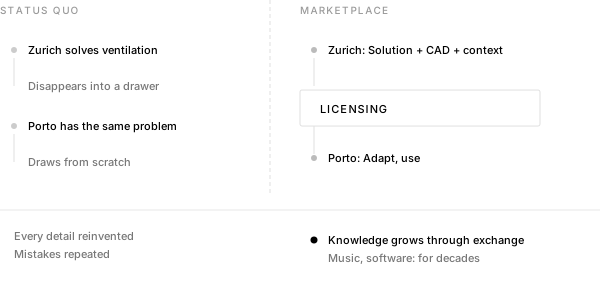
Every building is unique, every design is always a one-off, the architect can at most pull his unrealized plans back out of the drawer, but more exchange than that I have honestly never seen. I have built three houses. Always the same approach. It was certainly not due to the complexity of the details. A window seal is a window seal and a solution for sound insulation between two apartments follows physical laws, there is little artistic freedom in that.
In mechanical engineering this has felt solved for a hundred years. Nobody reinvents a ball bearing because there are standards, catalogs and standardized components. Granted, those exist in architecture from system suppliers too, but that is where the next problem lies. There are manufacturer portals or manufacturer-sponsored portals, but no free exchange that offers solutions across manufacturers or systems for reuse or purchase. In software it is also better solved. Open-source libraries, APIs, modules. Nobody programs a login screen from the ground up but takes a solution that works and builds on top of it. In architecture there is no platform where an architect can upload his solved window seal with CAD data, materials list and context description so that others can license, adapt and use it.
The reason for this is certainly also technical in nature. How do you protect intellectual property on a drawing, how do you ensure the creator is fairly compensated and how do you prevent simple copying. When the tokenization trend emerged and IP protection on the blockchain suddenly became possible without complex infrastructure, the situation changed. Smart contracts can automate licensing models, digital signatures protect authorship and transactions are traceable. The technology for this has long existed, but the industry needs to open itself to modern approaches to trade.
If architects could make their solved details, constructions and design modules available as licensable components, something entirely new would emerge. The architect in northern England earns from his window detail solution even though he has never seen the building in southern Germany. The architect in southern Germany saves weeks of detail planning and can focus on what is truly unique, namely a fully developed building where no water comes in.
What is really missing is a global exchange of architectural knowledge where it is not about copies but about further development. And where the architect is freed from the Sisyphean work that keeps him from doing what he does best.
How these texts are written is explained here.