Placebo Is a Business Model
It started in 2010. Silicone bracelet with a hologram, 39.90 a piece. I sold them. Not briefly and not as a side job, but as a European wholesale operation with exclusive licenses. I sold directly online, at sports events, trade shows, and then the sports and lifestyle retail sector followed. The pitch was simple and effective: you hold your arm out, someone pushes against it, you topple over. Then the bracelet goes on your wrist and suddenly you’re standing firm. People were amazed every single time.
Whether the effect actually came from the bracelet, I still don’t know. The studies pointed to placebo. But that didn’t matter, because people felt it. When someone feels something, it’s real to them.
The marketing was just as simple. You need a story that’s bigger than the product. Energy, frequency, balance — words that sound like science without being scientific. The most effective part was the people who wore it publicly. Athletes, actors, testimonials from around the world. It happened so fast. But it always came down to that one moment when the customer feels something in their own body and thinks it’s coming from outside. That moment is enough.
The pattern always works the same way. Someone expects an effect and experiences it for that reason. It’s an ancient placebo principle. And the experience confirms the belief and the belief generates demand. At the end stands someone who says: It helped me. And that didn’t just feed one company and its employees — it became a market for energy bracelets. Power Balance bands became the epitome of an entirely new product segment.
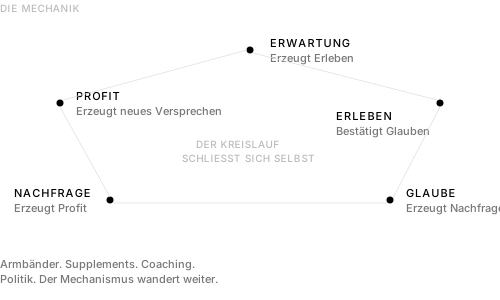
At some point the media started reporting more critically, talked about quackery, and the first lawsuits came. The hype was over. But the mechanism didn’t disappear. It has always existed and it won’t go away.
I had also sold dietary supplements. They don’t require proof of efficacy. The ingredients were known, and when the packaging says “supports your wellbeing”, that’s not wrong. But it suggests more than what’s actually proven. In coaching, a person with a compelling story tells others how to change their lives. The results are subjective, measured in testimonials and success stories. What exactly worked, nobody asks, because many business models are built not on critical questions but on effects and success stories, and they succeed that way.
The best salesperson I ever encountered never gave me the feeling he was trying to push something on me. He patiently explained everything and gave me all the time in the world to think about it.
The mechanism with the bracelet was different. Deep inside us sits the desire for something that just helps, no matter the problem. No ifs or buts, because we sometimes need that. We are often in need of help, even more so in stressful and demanding phases of life. And this desire or this need sits deep. Deeper than our reason.
I don’t want to moralize. Because I was part of it myself. Did I sell belief, wrapped in silicone, fitted with a hologram, suggesting it would solve your problem? Yes, I did. And I didn’t just learn that it works well, but also how it works.
Because the question is not whether people let themselves be deceived. They do, and that’s not a weakness. The far more important question for me is how we deal with it. Especially as sellers. Whether we accept that the desire to believe is a market, or whether we want more rules to limit these markets. Placebo is a powerful trigger for many business models. Not because the providers are malicious, but because it’s enough to deliver what people want and need.
I learned this intensely. It’s my own experience. I’ve read theories about it in books. But the experiences I had are far more intense than the theory in books. What I learned from it, I try to explore not just as theoretical answers but as practical questions in my essays.
How these texts are written is explained here.