The Question Behind the Question
I often hear the sentence: I’m stuck, I can’t move forward.
What lies behind it is different every time but has a common denominator. Sometimes the trigger is a job that hasn’t fit for years. Sometimes a layoff that just happened. More and more often it is “just” the feeling that everything works but the meaning is missing. What they all share: They know that something has to change, but nobody really understands the what.
Getting advice is one of the first approaches. Through strengths analysis, personality tests, systemic methods, coaching basically. You get asked what can you do, what do you want, what are your dreams, what matters to you and then comes the result in the form of a plan or a checklist or something that is supposed to be your tool.
But often it doesn’t work. And I don’t say that because I’m personally not a fan of systemic coaching or because the tools are bad. But because they skip a question that in my view should come first.
When someone says “I need more freedom,” that’s not a statement. It’s a door. Behind it could be financial independence, control over one’s time, the absence of a particular boss, authority over one’s own work and much more. These are all different things leading to very different individual decisions. But most conversations about career change take such words at face value and have already moved to the next step before it’s been clarified what the person actually means.
What do you mean when you say “success”? Is that your personal success or the one you learned to want because success follows a stereotype whose pressure you can’t unconsciously escape? What do you mean when you say you want to do “something meaningful”? I believe that behind “meaningful” lies a very personal need that requires no moral anchor.
This sounds like a philosophical exercise. But it’s not. It’s a very pragmatic question that needs to be asked. Because the answer determines which direction someone takes who is standing at a real crossroads with no signposts.
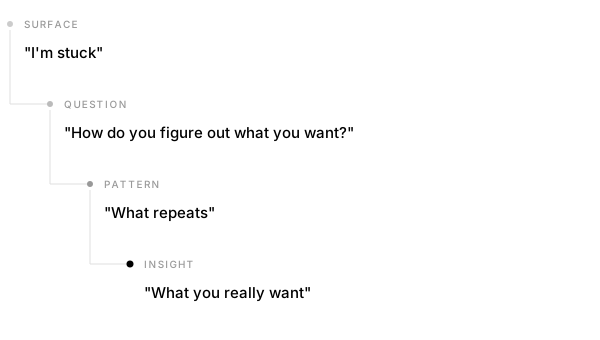
I went through such a process myself. With a psychologist who has worked with biography for decades. The experience changed how I think about career decisions. Not because the process gave me an answer. But because it showed me I already carried the answer inside. I just hadn’t observed my own thoughts carefully enough and then used the wrong words for them on top of it.
The system I have since adapted is based on an assumption that sounds counterintuitive: The most reliable indicator of your future is your past.
Not your wishes. Not your ideas about who you could be. But what actually happened. What made you satisfied will make you satisfied again. What frustrated you will frustrate you again. Most people thinking about change look forward. They design a future based on hopes. Looking back would be more reliable because biography doesn’t lie.
The process works with stories. Someone tells six key moments from their life and through conversation it becomes visible what repeats itself. What someone tells you is crucial. But what someone doesn’t tell you could often be more important or at least equally important. The misconception is that in a conversation about one’s inner world the right memories or thoughts automatically surface right away. The assumption is that the patterns that emerge are more reliable than any self-assessment. Because they are not based on what someone believes about themselves but on what they have actually done.
Seven dimensions form the framework I have designed for such conversations. What someone can do. How their story has unfolded. What kind of people they want to work with. What satisfies them. Under what conditions they function. What truly matters to them. And where all of this concretely leads. Each dimension is its own question and each question builds on the answers to previous ones. “I want to work with smart people” does not mean the same as “I can’t work with people who just mindlessly execute.” Even though both can come from the same mouth.
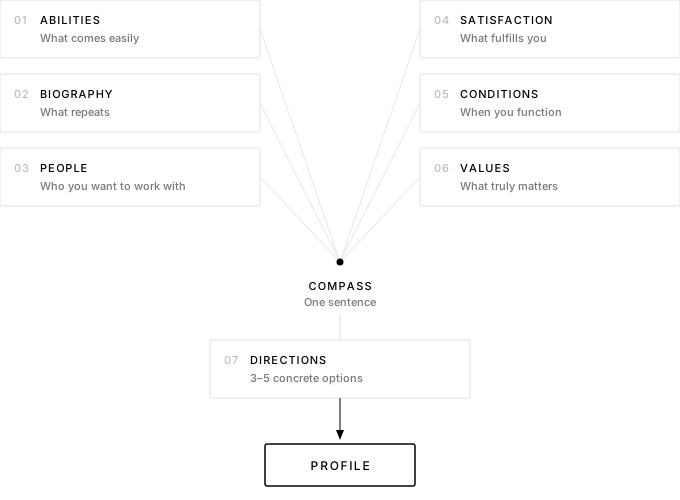
The result is not advice and not a plan. For me it is a profile of abilities, patterns, values, conditions, an inner compass and concrete directions. Solid enough to test decisions against. Not because someone else says: This is right for you. But because the person themselves recognizes what fits and what doesn’t. “Fits” sounds casual here but often feelings don’t express themselves any more concretely than that, even when they clearly point the way.
Self-knowledge is the hardest form of knowledge. You are simultaneously researcher and subject. You can’t observe yourself from the outside. You need someone who listens and reflects back what they see. Not as diagnosis but as translation, so that the often diffuse feelings and thoughts can take concrete shape. In other words all the things you already know but have never been able to clearly articulate or put into words that can actually carry you across that crossroads.
Career clarity does not start with the first available answer. It emerges from the right questions that need to be asked individually so they can bring light into the fog.
How these texts are written is explained here.