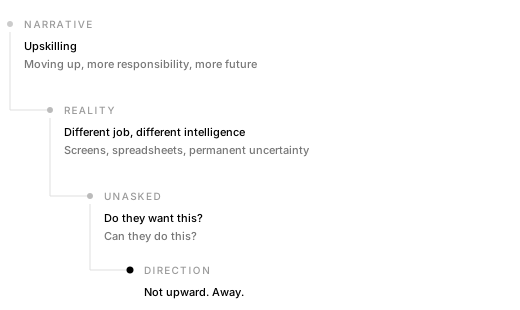
An example that keeps coming up in my conversations with former colleagues: a company automates its warehouse. The staff who used to count inventory and sort goods by hand get retrained for strategic logistics, supply-chain optimisation and data analysis, the kind of decisions that used to sit with managers. The company calls this upskilling.
What unsettles me is how ordinary this has become. People who spent years doing physical work are asked to think strategically now. Nobody asked whether they want that or whether they can do it. The company asks because it has to move them somewhere, now that artificial intelligence has taken their old position. Occasionally the move is announced outright; more often it arrives dressed up as an opportunity, handed over quietly.
Upskilling sounds like a promotion: more responsibility, a raise, a new title. In practice it often means something narrower. You lose the job you were good at and get one you might not be able to do.
What the job actually was
The old job had clear procedures, physical effort and a result you could see at the end of the day. A shelf was stocked or it wasn’t. The new job replaces that with screens, spreadsheets and meetings, plus a permanent low-grade doubt about whether you understand what you are doing.
I worked for many years as a strategic consultant and I know the responsibility that comes with having to make clear decisions. And I know it’s not everyone’s thing. Through most of that work, a constant uncertainty about whether a call was right stayed with me, and I used it as a traffic light: go, stop or wait for more data. That uncertainty was part of the job description for me. Handing it to someone who spent fifteen years counting pallets, with a weekend course and a new title, is a different proposition.
Two questions nobody asks
The first question is want. Some people chose physical work on purpose. They are good at it and it suits them, and it has nothing to do with a lack of alternatives. A warehouse that is tidy at the end of a shift is satisfying in a way no job description captures. That pride in physical work is real, whatever the appraisal form measures instead. These are the people now told to treat a move to a screen as a growth opportunity.
The second question is can. Strategic thinking takes more than a three-day workshop. It is a way of processing information that forms over years, and some people develop it and some do not. That difference comes down to which kind of intelligence someone has built over the years, not to how much of it they have. Someone who keeps the whole warehouse layout in their head, who knows every position and feels a bottleneck before it shows up in the numbers, has a capability no course teaches, and none of the new job descriptions ask for it. They ask for a set of softer, less tangible skills, and where something concrete is required it tends to be judgement built the same slow way, over years on the floor.
If I want to learn something new, it usually comes with more responsibility. That has been true in my own work. It is a different matter to demand the same trade from someone who never asked for the extra weight and did not choose the direction it points in.
The word doing the work
As so often I only hear success stories: staff “empowered”, a transformation “delivered”. What goes unsaid is how many people gave up along the way, or finished the retraining and ended up doing work they do not understand, work that frustrates them and eventually burns them out, because it was sold to them as fulfilling and as advancement and turned out to be neither.
In my years as a consultant I heard a specific word for this: redeployment. Stripped down, it means the company no longer needs you for what it hired you to do, so it will not let you go outright. It gives you something else and calls it better. That sounds humane on paper. In practice I’ve often seen a slow farewell. People notice over months that they cannot keep pace in the new role, and the loss of confidence spreads from the job to themselves and to the company that put them there. They keep the position without ever really doing the job.
The honest version would read differently: we automated these jobs, some people adapted and some did not, and for the ones who did not there is no plan that actually works. Upskilling succeeded for some of the people who went through it. For others it started as an appealing challenge and turned into something they could not manage.
That honesty does not fit on a slide. The word upskilling implies a direction: upward, more capable, more valuable, a future secured. My experience is that this really works only for the very few.