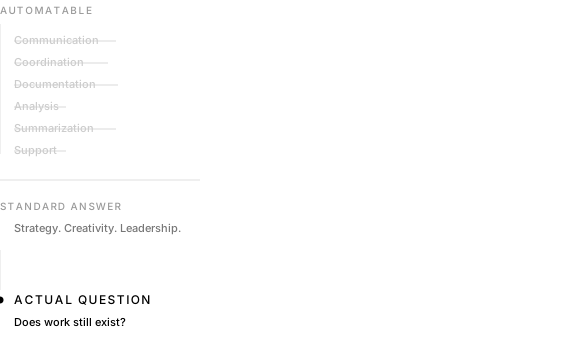
I tried to name a job description that isn’t on the list of tasks artificial intelligence can now do. I didn’t find one.
The list keeps growing. Scheduling meetings. Answering emails. Writing reports. Summarising meetings. Running customer support. Generating leads. Managing a project from start to finish. Onboarding a new customer. None of these are edge cases. Together they cover most of what an office job actually consists of.
I spent over thirty years inside organisations, as a consultant, as an owner, a partner, a team member, in the most varied industries. My own working days consisted of preparing meetings, summarising results, writing emails, producing reports, coordinating people. That work was the job. A summary of a meeting was where the decision got recorded. An email often settled a conflict that would otherwise have cost a client.
The category and the situation
The forecasts of which of these tasks survive make one consistent mistake. They take the category of a task and conclude something about every instance of it. Answering emails becomes a single line on the list, and the list says that line can be automated. But an email to a customer who is furious, three sentences that work because you understood what he actually meant underneath his complaint, has almost nothing in common with an email proposing a meeting time next Tuesday. It is the same activity, but a different task.
Automation sorts by category, but a person still has to read the situation inside it. Customer support is a category that contains a thousand different moments. Nine hundred of them can in fact be automated. A hundred of them can’t, and those hundred are what a customer actually remembers, the moments that leave him with the sense that someone was listening. I’ve seen moments myself where a deep customer relationship came out of a complaint. That relationship comes only from the hundred moments outside the category.
Where strategy actually comes from
The usual response to this problem is that strategy, creativity and leading people remain human work, whatever else gets automated. I looked at part of this question in my own book, right at the start of the AI applications we now use daily, and the answer felt thin even then. A strategy doesn’t form on its own. It comes out of exactly the meetings and the emails and the reports that organisations now hand to a machine first. Remove the material and there’s nothing left to build a strategy out of. What remains is a person in an office who no longer has anything to think about, because a machine has already processed every piece of information that used to feed that thinking.
None of this makes me an opponent of automation. A large part of what’s on that list is repetitive, and repetitive tasks are where fatigue and errors creep in. A machine does that part better than I ever did over thirty years of doing it by hand. The uncomfortable part is what comes after: once the repetitive share and a good part of the exceptional share have both been taken by a machine, what is actually left for a person.
I don’t have an answer. I haven’t come across anyone who has followed this list all the way to where it actually leads. Something I myself didn’t want to say out loud for a long time is there at the end of it, and it reaches past which jobs survive: whether there is any work left that a human has to do, because a machine cannot do it, in an economy that may no longer need the person doing it.